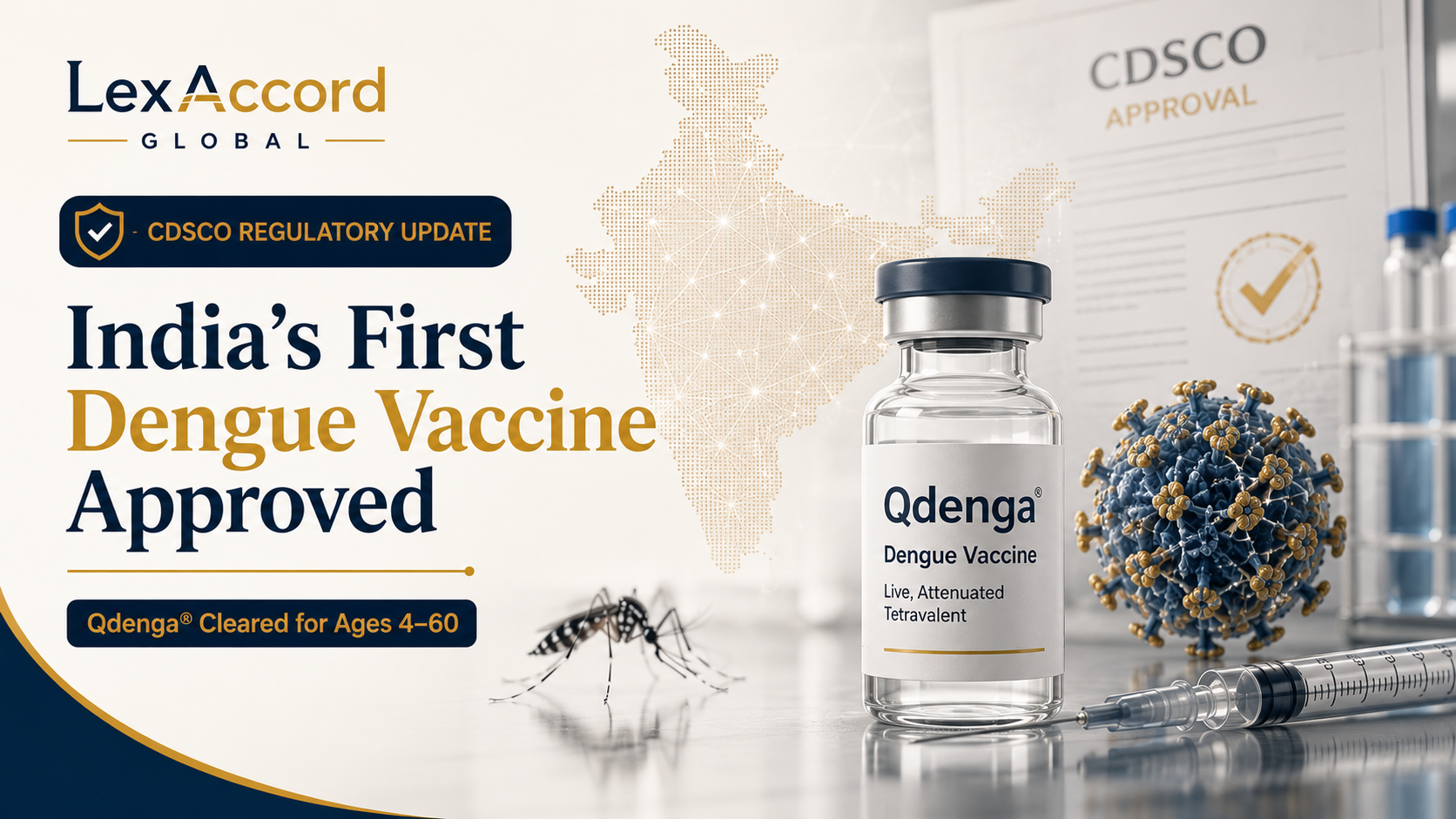
India has reached an important vaccine-regulatory milestone. The Central Drugs Standard Control Organisation (CDSCO), under the Ministry of Health and Family Welfare, has granted marketing authorisation for Qdenga®, the first dengue vaccine approved in India.
The approval is significant for public health, but it also has immediate regulatory and operational relevance for pharmaceutical companies, authorised importers, distributors, healthcare institutions, clinical-research organisations and cold-chain partners. Each entity involved in bringing the vaccine to patients must work within the approved indication, product information, licence scope and applicable supply-chain controls.
Importantly, Qdenga® is the first dengue vaccine approved in India; the official release does not describe it as an indigenously developed vaccine. It is manufactured by Takeda GmbH in Germany and is to be imported by Takeda Biopharmaceuticals India Pvt. Ltd. The Ministry announced the approval through PIB on 21 July 2026.
At a glance
| Item | Verified position |
|---|---|
| Regulatory development | CDSCO granted marketing authorisation for India’s first approved dengue vaccine |
| Product | Dengue Tetravalent Vaccine (Live, Attenuated) – Qdenga® |
| Manufacturer | Takeda GmbH, Germany |
| Indian importer | Takeda Biopharmaceuticals India Pvt. Ltd. |
| Approved indication | Prevention of dengue disease in individuals aged 4–60 years |
| Dosage schedule | Two 0.5 mL doses administered three months apart, at months 0 and 3 |
| Administration | Subcutaneous injection after reconstitution |
| Announcement date | 21 July 2026 |
| Industry-wide deadline | No separate implementation deadline was specified in the official announcement |
CDSCO Dengue Vaccine Approval: What Changed?
Direct answer: CDSCO has granted marketing authorisation for Qdenga®, a live, attenuated tetravalent dengue vaccine, for the prevention of dengue disease in people aged 4–60 years.
The Ministry stated that the approval followed a scientific assessment of the vaccine’s quality, safety and efficacy under the Drugs and Cosmetics Act, 1940 and the Drugs Rules, 1945.
The approval is supported by a global clinical-development programme covering dengue-endemic and non-endemic regions. The regulatory evaluation also included a pivotal Phase III safety and immunogenicity study in Indian participants aged 4–60 years.
CDSCO Dengue Vaccine Approval Covers Qdenga®
Direct answer: The approved product is Dengue Tetravalent Vaccine (Live, Attenuated), marketed as Qdenga®.
According to the Ministry’s release, Qdenga®:
- is a live, attenuated tetravalent vaccine developed using recombinant DNA technology;
- uses a dengue virus type-2 backbone with genes encoding serotype-specific surface proteins;
- is produced in Vero cells and contains genetically modified organisms;
- is supplied as a freeze-dried powder that must be reconstituted; and
- is administered by subcutaneous injection.
These characteristics are relevant not only to prescribers but also to regulatory, quality, storage, handling and pharmacovigilance teams responsible for maintaining the product within its authorised conditions.
Approved Age Group and Qdenga® Dose Schedule in India
Direct answer: Qdenga® is approved in India for individuals aged 4–60 years and is administered in two 0.5 mL doses, three months apart.
The approved schedule is:
- First dose: Month 0
- Second dose: Month 3
Healthcare providers and commercial teams should rely on the final India-approved prescribing information for patient selection, contraindications, warnings, administration, storage and safety reporting. Global labels or promotional material from another jurisdiction should not be treated as a substitute for the approved Indian product information.
Is Qdenga® India’s First Indigenous Dengue Vaccine?
Direct answer: No. It is India’s first approved dengue vaccine, but the approved product is manufactured in Germany and imported into India.
This distinction matters for accurate regulatory communication. Content should not describe Qdenga® as “India’s first indigenous dengue vaccine” or imply that it was developed or manufactured domestically unless supported by a separate verified authorisation.
The Indian approval nonetheless reflects CDSCO’s assessment of data that included an Indian Phase III study and represents a significant addition to the country’s dengue-prevention options.
Marketing Authorisation Is Not the Same as a National Vaccination Rollout
Direct answer: The approval permits the authorised product to progress toward the Indian market; it does not, by itself, announce inclusion in a government immunisation programme.
The Ministry stated that the vaccine is expected to complement vector control, surveillance, early diagnosis and case-management measures under India’s national vector-borne disease programme. It did not announce universal deployment, public procurement, inclusion in the Universal Immunisation Programme or an industry-wide implementation mandate.
Businesses and healthcare institutions should therefore distinguish among:
- regulatory marketing authorisation;
- commercial launch and product availability;
- institutional procurement or formulary adoption; and
- any future government vaccination policy.
Each of these may involve separate decisions, conditions and timelines.
Who Is Affected by the CDSCO Qdenga® Approval?
Direct answer: The approval is most relevant to the marketing-authorisation holder, importer, licensed distributors, healthcare providers, cold-chain operators, pharmacovigilance teams and clinical-research partners.
Importer and Marketing-Authorisation Teams
They should ensure that imports, product release, labels, prescribing information and market activity remain aligned with the approved licence and any post-approval commitments.
Pharmaceutical Distributors and Supply-Chain Partners
Distributors should verify their authorisations, approved supply relationships, storage requirements, traceability systems, transportation controls and handling procedures before undertaking commercial activity.
Hospitals, Clinics and Healthcare Providers
Healthcare institutions should establish product-receipt, storage, prescribing, administration, recordkeeping and adverse-event reporting processes based on the final India-approved information.
Clinical-Research Organisations and Laboratories
CROs and laboratories may need to maintain trial-data integrity, safety follow-up, sample controls, document retention or post-authorisation evidence systems where their contractual scope continues after approval.
Medical, Promotional and Digital-Content Teams
All claims should remain consistent with the authorised indication and approved product information. Content should avoid implying guaranteed protection, use outside the approved population or government-programme endorsement.
Qdenga® Commercialisation Compliance Checklist for India
Direct answer: Before launch or distribution, businesses should verify the approval scope, product information, licence coverage, supply-chain controls and post-marketing responsibilities.
1. Confirm the Exact Approval Scope
Review the marketing authorisation, approved indication, age range, dosage form, route, schedule, manufacturer, importer and any regulatory conditions.
2. Use India-Approved Product Information
Align labels, package inserts, educational materials, digital content and promotional claims with the final Indian prescribing information. Do not automatically reuse content approved in another market.
3. Verify Licence and Authorisation Coverage
Confirm that each importer, stocking point, distributor and commercial partner holds the approvals applicable to its role and that the proposed activity falls within the relevant authorisation.
4. Validate Storage and Distribution Controls
Document the applicable temperature, handling, reconstitution, transportation and excursion-management requirements from the approved product information and quality system. Qualify logistics partners accordingly.
5. Establish Traceability and Recordkeeping
Ensure batch-level traceability across import, receipt, storage, distribution and administration channels. Records should support investigation, recall and regulatory review if required.
6. Review Pharmacovigilance Readiness
Clarify adverse-event intake, escalation, assessment, reconciliation and reporting responsibilities across the importer, healthcare institutions, service providers and commercial partners.
7. Control Medical and Promotional Claims
Implement medical, legal and regulatory review before releasing advertising, professional education or public-facing content. Avoid expanding the approved indication through wording, imagery or omission of material context.
8. Track Post-Approval Changes
Changes to manufacturing, specifications, packaging, labelling, sites, testing, safety information or supply arrangements should be assessed for prior approval, notification or documentation requirements before implementation.
Effective Date, Deadline and Expected Market Availability
Direct answer: The approval was announced on 21 July 2026, and the official release did not prescribe a separate industry-wide compliance deadline or confirm immediate retail availability.
Marketing authorisation should not be interpreted as confirmation that stock is immediately available across India. Reuters reported that Takeda expected initial availability through private healthcare settings in the first half of 2027. This is a reported commercial-launch expectation, not a general statutory deadline.
Organisations planning procurement, distribution or administration should confirm product availability and the applicable commercial and regulatory documentation directly through authorised channels.
Global Regulatory Context for Qdenga®
Direct answer: Qdenga® had already received approvals in multiple international markets and WHO prequalification before the Indian authorisation.
The Ministry reported that the vaccine was approved in 42 countries, including the European Union, United Kingdom, Switzerland, Indonesia, Malaysia and Thailand. It also reported distribution of more than 24 million doses globally and a favourable post-marketing safety profile without significant safety concerns identified at the time of the announcement.
The World Health Organization prequalified TAK-003, the vaccine marketed as Qdenga®, in May 2024. WHO’s global recommendation concerns children aged 6–16 years in settings with high dengue burden and transmission intensity. That recommendation should not be confused with India’s approved indication of 4–60 years; national marketing authorisations and public-health recommendations serve different regulatory and policy functions.
Why the First Dengue Vaccine Approval Matters for India
Direct answer: The approval adds a regulated vaccination option to India’s dengue-prevention framework while reinforcing the need for coordinated post-approval, supply-chain and safety controls.
The development demonstrates the role of science-based regulatory review in making globally evaluated vaccines available in India. For the pharmaceutical sector, it also highlights the full lifecycle of vaccine compliance—from clinical evidence and marketing authorisation to import, distribution, approved communications, pharmacovigilance and change management.
Vaccination does not replace mosquito-control measures, disease surveillance, timely diagnosis or appropriate clinical management. The Ministry expressly positioned the vaccine as complementary to these measures.
How LexAccord Global Can Support Pharmaceutical and Vaccine Compliance
Direct answer: LexAccord Global helps pharmaceutical businesses plan and manage regulatory submissions, licensing, post-approval changes and market-entry compliance in India.
Our support may include:
- regulatory pathway and submission planning;
- pharmaceutical import and licensing support;
- review of approval scope and regulatory documentation;
- post-approval change assessment and submission coordination;
- label, package insert and promotional-content compliance review;
- distribution and supply-chain authorisation assessment;
- pharmacovigilance and compliance-process coordination; and
- ongoing regulatory intelligence and lifecycle-compliance support.
Businesses preparing to import, commercialise, distribute or support regulated pharmaceutical products should complete an approval-specific compliance review before undertaking market activity.
Conclusion
CDSCO’s approval of Qdenga® is a landmark for dengue prevention in India and an important development for the country’s pharmaceutical regulatory ecosystem. The vaccine is approved for people aged 4–60 years in a two-dose schedule administered three months apart.
For industry stakeholders, the approval is the beginning of the commercial-compliance phase—not the end of regulatory responsibility. Import controls, licence scope, approved product information, storage, traceability, pharmacovigilance, promotional review and post-approval change management must remain aligned throughout the product lifecycle.
LexAccord Global supports pharmaceutical licensing, regulatory submissions and post-approval compliance for businesses entering or expanding in the Indian market.
Frequently Asked Questions
1. What is India’s first approved dengue vaccine?
India’s first approved dengue vaccine is Dengue Tetravalent Vaccine (Live, Attenuated), marketed as Qdenga®. CDSCO granted it marketing authorisation for the prevention of dengue disease in individuals aged 4–60 years.
2. Who manufactures and imports Qdenga® in India?
Qdenga® is manufactured by Takeda GmbH, Germany. The official announcement identifies Takeda Biopharmaceuticals India Pvt. Ltd. as the Indian importer.
3. Is Qdenga® an indigenous Indian dengue vaccine?
No. It is the first dengue vaccine approved for use in India, but the approved product is manufactured in Germany and imported into India.
4. What is the approved Qdenga® age group in India?
The vaccine is approved in India for individuals aged 4–60 years. Healthcare professionals should follow the final India-approved prescribing information when assessing suitability.
5. What is the approved dose schedule?
The recommended immunisation schedule consists of two 0.5 mL doses administered three months apart, at months 0 and 3. The vaccine is administered subcutaneously after reconstitution.
6. Does CDSCO approval mean Qdenga® is immediately available everywhere in India?
Not necessarily. Marketing authorisation and commercial availability are different milestones. The official 21 July 2026 release did not confirm immediate nationwide retail availability.
7. Has Qdenga® been added to India’s Universal Immunisation Programme?
The official approval announcement did not state that Qdenga® had been included in the Universal Immunisation Programme or another nationwide government vaccination rollout.
8. What should distributors and healthcare institutions verify before handling the vaccine?
They should verify the approved product information, licence scope, authorised supply chain, storage and transportation requirements, traceability processes, staff procedures and pharmacovigilance responsibilities.