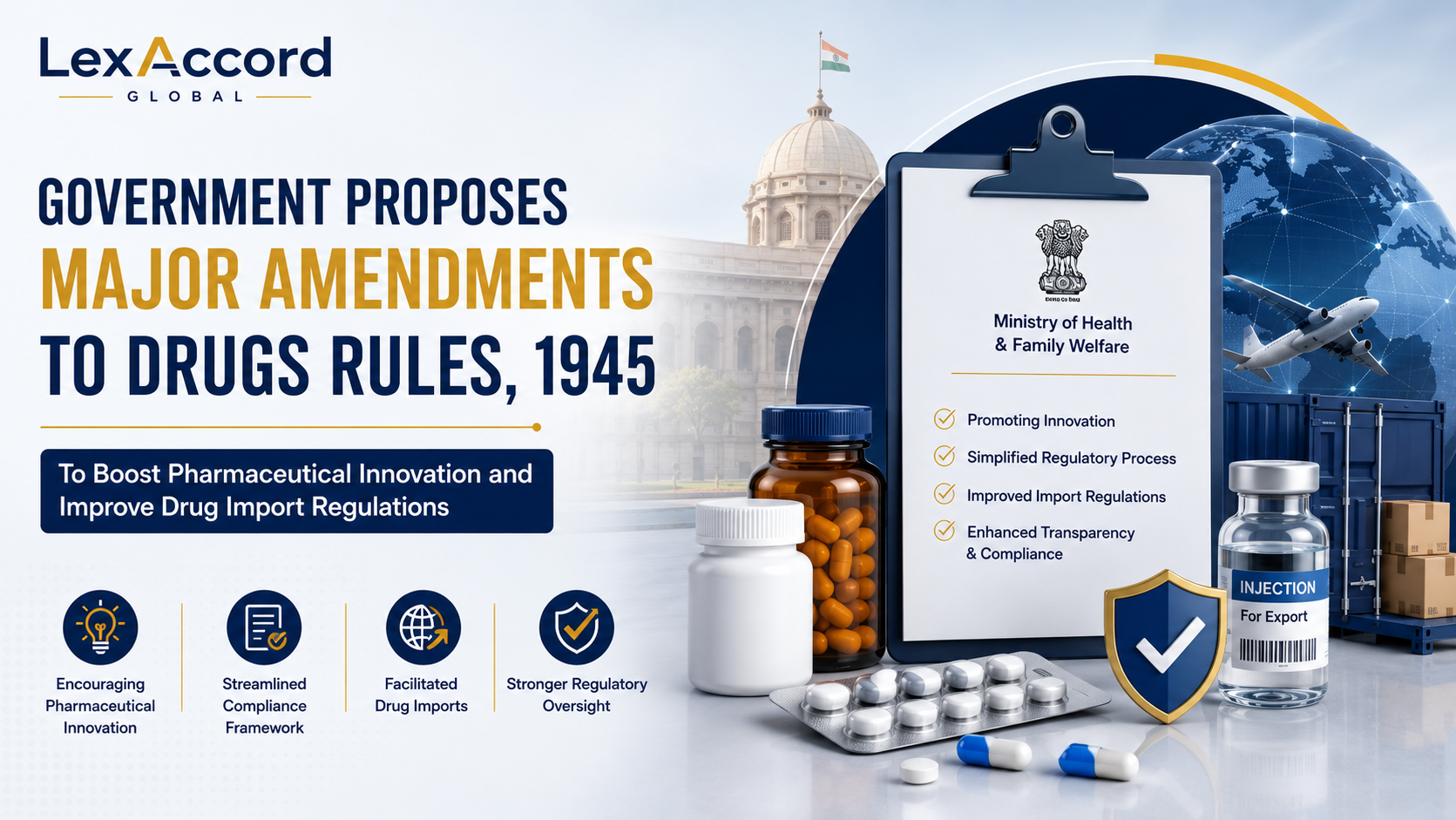
The Ministry of Health and Family Welfare (MoHFW) has released two important draft notifications proposing amendments to the Drugs Rules, 1945, marking another significant step towards strengthening India’s pharmaceutical regulatory ecosystem.
The proposed reforms focus on:
- Simplifying the import procedure for drugs intended for examination, testing, or analysis (Form 11).
- Rationalising the residual shelf-life requirements for imported medicines.
Together, these initiatives aim to reduce regulatory complexity, encourage pharmaceutical innovation, improve supply chain efficiency, and further enhance the ease of doing business in India’s healthcare sector.
1. Simplified Import Procedure for Drugs Used in Testing and Research (Form 11)
One of the most notable proposals is the introduction of an acknowledgement-based notification system for importing small quantities of drugs intended solely for analytical and non-clinical testing purposes.
Current Process
Under the existing framework, applicants are generally required to obtain regulatory permission before importing drugs for examination, testing, or analysis under Form 11, often resulting in additional administrative timelines.
Proposed Change
The draft amendment proposes replacing the licensing process with a simplified online notification mechanism.
Applicants will only need to:
- Submit a prior intimation online.
- Receive an automated acknowledgement.
- Import the drugs immediately after acknowledgement is generated.
This removes the requirement for prior approval in eligible cases and significantly accelerates research-related imports.
Drugs Covered Under the Simplified System
The proposed acknowledgement-based mechanism will apply to small quantities of drugs imported exclusively for:
- Analytical testing
- Quality evaluation
- Laboratory examination
- Non-clinical research
- Research & Development (R&D)
Categories Still Requiring Prior Licence
Certain high-risk categories will continue to require regulatory approval before import, including:
- Sex hormones
- Cytotoxic drugs
- Beta-lactam drugs
- Biologics containing live microorganisms
- Narcotic drugs
- Psychotropic substances
These exclusions ensure that products with greater safety or public health implications remain subject to appropriate regulatory oversight.
Expected Benefits
The proposed reform is expected to:
- Reduce compliance burden on pharmaceutical companies
- Eliminate unnecessary licensing for eligible imports
- Accelerate research and product development
- Support pharmaceutical start-ups and innovators
- Enable faster analytical and laboratory testing
- Promote digital regulatory processes through an online acknowledgement system
The proposal also expands upon similar amendments introduced earlier in January 2026 under the New Drugs and Clinical Trials Rules, 2019, which simplified domestic test licences.
2. Proposed Revision to Residual Shelf-Life Requirements for Imported Drugs
In a separate draft notification, the Ministry has proposed revising Rule 31 of the Drugs Rules, 1945, governing the minimum residual shelf-life of imported medicines.
Existing Requirement
Currently, imported drugs are generally required to have more than 60% of their approved shelf life remaining at the time of import.
Since this requirement varies depending on the product’s total shelf life, it creates inconsistent compliance obligations across different medicines.
Proposed Requirement
The Government has proposed replacing the percentage-based requirement with a uniform rule:
Imported drugs must have a minimum residual shelf life of 12 months at the time of import.
This simplified approach provides greater regulatory clarity while ensuring medicines continue to have sufficient usable life after entering the Indian market.
Exceptions
The existing requirement of more than 60% residual shelf life will continue to apply for:
- Biological products
- Radiopharmaceuticals
These products have specialised characteristics and require additional safeguards due to public health considerations.
Benefits of the Proposed Shelf-Life Amendment
The proposed revision is expected to deliver multiple operational benefits across the pharmaceutical supply chain.
Reduced Medicine Wastage
A fixed 12-month requirement will minimise unnecessary rejection of otherwise safe medicines solely due to percentage-based calculations.
Improved Inventory Management
Manufacturers and importers will have greater flexibility in inventory planning and distribution.
Stronger Supply Chain Efficiency
Simplified import norms are expected to reduce logistics challenges and optimise stock utilisation.
Lower Operational Costs
Reduced wastage and improved inventory utilisation can help lower warehousing and supply chain costs.
Improved Availability of Critical Medicines
The proposal may particularly benefit imports of:
- Oncology medicines
- Rare disease therapies
- High-value biologics
- Other specialised imported pharmaceuticals
No Change to Drug Quality or Safety Standards
Importantly, the Ministry has clarified that these amendments only modify the import procedure and residual shelf-life requirement.
There are no changes to existing regulatory standards relating to:
- Drug quality
- Safety
- Efficacy
- Manufacturing standards
- CDSCO regulatory oversight under the Drugs and Cosmetics Act, 1940
Patient safety and product quality remain fully protected.
Impact on the Pharmaceutical Industry
If implemented, these amendments are expected to have a positive impact on:
- Pharmaceutical manufacturers
- Drug importers
- CROs
- Research laboratories
- Biotechnology companies
- Medical research institutions
- Start-ups engaged in pharmaceutical innovation
The reforms support the Government’s broader objective of creating a modern, efficient, and innovation-friendly regulatory environment while maintaining robust public health safeguards.
LexAccord Global’s Perspective
The proposed amendments represent another progressive step towards regulatory simplification in India’s pharmaceutical sector. By reducing procedural hurdles for research imports and introducing a practical, uniform residual shelf-life requirement, the Government is enabling faster innovation, improving supply chain efficiency, and enhancing ease of doing business.
While the amendments are currently in the draft stage, pharmaceutical companies should proactively evaluate how these changes may affect their import strategies, regulatory compliance processes, and R&D operations. Early preparation will ensure a smooth transition once the revised rules are notified.
At LexAccord Global, we closely monitor CDSCO notifications and regulatory developments to help pharmaceutical companies navigate evolving compliance requirements with confidence.
Need Support with CDSCO Regulatory Compliance?
LexAccord Global provides end-to-end regulatory and compliance services for the pharmaceutical, medical device, cosmetics, nutraceutical, and healthcare industries.
Our expertise includes:
- CDSCO Import Registration
- Drug Import Licences
- Form 11 Regulatory Support
- Regulatory Strategy & Gap Assessment
- Product Registration
- Manufacturing Licence Support
- Regulatory Intelligence & Compliance Advisory
- Post-Approval Lifecycle Management
Stay updated with the latest CDSCO regulatory developments by following LexAccord Global.
Frequently Asked Questions (FAQs)
1. What changes has the Government proposed under the Drugs Rules, 1945?
The Ministry of Health and Family Welfare has proposed two key amendments to the Drugs Rules, 1945:
- Introducing an acknowledgement-based system for importing small quantities of drugs for examination, test, or analysis (Form 11).
- Revising the residual shelf-life requirement for imported drugs from more than 60% of approved shelf life to at least 12 months remaining at the time of import, with certain exceptions.
2. What is Form 11 under the Drugs Rules, 1945?
Form 11 is the regulatory mechanism used for importing small quantities of drugs into India for purposes such as examination, laboratory testing, analysis, quality evaluation, or non-clinical research. The proposed amendment aims to simplify this process by replacing prior licensing with an acknowledgement-based online notification system.
3. How will the new acknowledgement-based import system work?
Under the proposed amendment, applicants will submit a prior online intimation for eligible drug imports. Once the system generates an acknowledgement, the importer can proceed with importing the drugs without waiting for a separate licence approval.
4. Which drugs are eligible under the simplified Form 11 import procedure?
The simplified procedure applies to small quantities of drugs imported exclusively for analytical and non-clinical testing purposes, including laboratory analysis, quality evaluation, and research and development activities.
5. Which drugs will continue to require prior import licensing?
The following categories will continue to require prior regulatory approval:
- Sex hormones
- Cytotoxic drugs
- Beta-lactam drugs
- Biologics containing live microorganisms
- Narcotic drugs
- Psychotropic substances
These products remain subject to stricter regulatory oversight due to safety and public health considerations.
6. What is the proposed change to the residual shelf-life requirement for imported drugs?
Currently, imported drugs generally need to have more than 60% of their approved shelf life remaining at the time of import. The Government has proposed replacing this with a simpler requirement of at least 12 months of residual shelf life at the time of import.
7. Are any products exempt from the new 12-month shelf-life requirement?
Yes. The existing requirement of more than 60% residual shelf life will continue to apply to:
- Biological products
- Radiopharmaceuticals
These products require additional regulatory safeguards due to their specialised nature.
8. Why is the Government proposing these amendments?
The proposed amendments aim to:
- Promote pharmaceutical research and innovation.
- Reduce regulatory burden for businesses.
- Improve ease of doing business.
- Enhance supply chain efficiency.
- Reduce avoidable wastage of medicines.
- Improve the availability of essential and specialised medicines in India.
9. Will these amendments affect the quality or safety standards of imported medicines?
No. The Ministry has clarified that the proposed amendments only relate to the import procedure and residual shelf-life requirements. Existing regulatory standards governing the quality, safety, efficacy, manufacturing, and regulatory oversight of medicines remain unchanged under the Drugs and Cosmetics Act, 1940 and the Drugs Rules, 1945.
10. How will pharmaceutical companies benefit from these proposed changes?
If implemented, pharmaceutical companies may benefit from:
- Faster import of drugs for testing and research.
- Reduced compliance and licensing burden.
- Improved inventory utilisation.
- Lower logistics and operational costs.
- Faster R&D timelines.
- Greater regulatory predictability.
11. Are these amendments currently in force?
No. These are draft amendments published by the Ministry of Health and Family Welfare for stakeholder consultation. They will become effective only after the Government issues the final notification.